
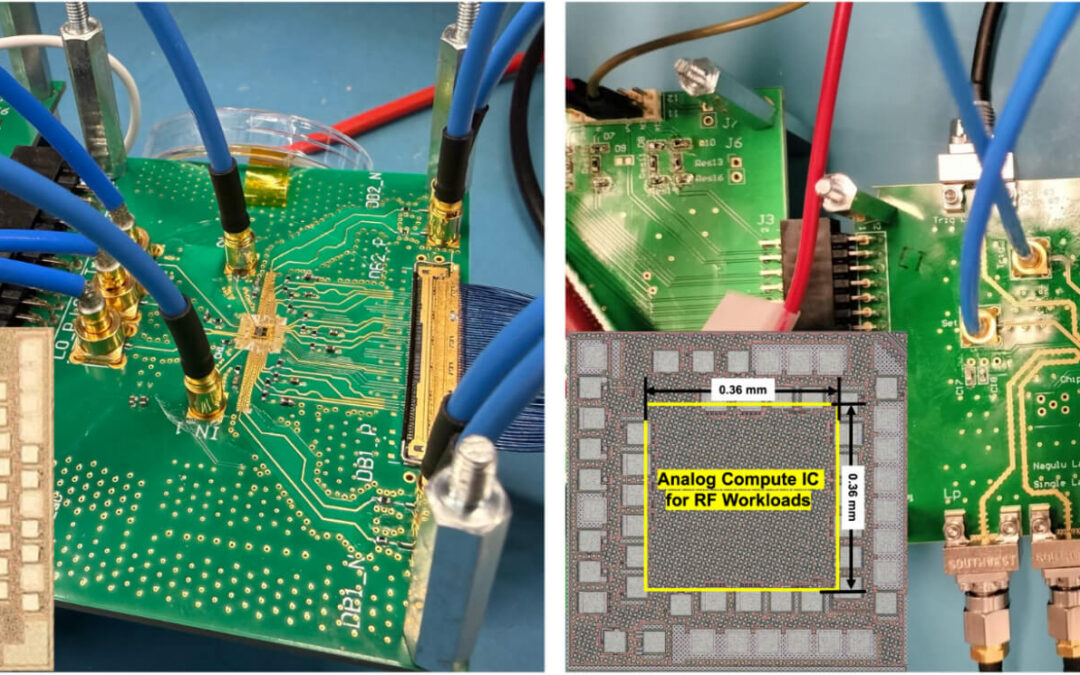
Aravind Nagulu, Northeastern assistant professor of Electrical and Computer Engineering and NanoSI faculty member, is part of a six-year, $9 million research effort funded by the U.S. Army to develop smaller, faster and more energy-efficient electromagnetic sensing systems.
Led by Duke University, the RAPTORS project “Rapid Analog Processing for Tactical Observation and Opportunistic Radio Spectrum Access,” brings together researchers from Duke, Northeastern, Yale University and Raytheon.
As wireless technologies proliferate, the electromagnetic spectrum is becoming increasingly crowded. The ability to rapidly detect, identify and interpret signals is critical for communications, radar and other technologies.
Nagulu Lab will work with Yale professor Arun Natarajan to develop radio-frequency integrated circuits that can process signals in the analog domain – much closer to where they are received – instead of transferring large amounts of data to conventional digital processors.
The approach builds on Nagulu’s research on a near-sensor, approximate-computing methodology developed for RF workloads including radars, spectrum sensors, and MIMO systems. His work explores how computation can be performed directly on the RF/analog signals received by the radio front-end; eventually reducing the data, power and hardware required to extract useful information.
“The closer we can process information to where the signal is actually received, the less data we need to move through the system. By performing more of that computation directly in the analog and RF domain, we have an opportunity to significantly reduce power consumption and processing requirements while still extracting the information that matters.” says Dr. Nagulu.
The project reflects a broader direction in Nagulu’s research vision of moving computation closer to where raw-data is generated and only pass-on useful information to the subsequent blocks.
For electromagnetic sensing, that could mean extracting meaningful information from a signal at the point of reception, rather than moving large volumes of raw data through a conventional processing chain.
“We envision transforming radio front ends from mere data-reception blocks into intelligent sensors capable of extracting critical information directly from raw electromagnetic signals.”
In RAPTORS, that capability will be combined with reconfigurable metamaterial antennas being developed at Duke, creating a tightly integrated sensing system designed around constraints including size, weight, power and cost.
Rather than treating the antenna, electronics and computing as separate components, the RAPTORS team is taking a systems-level co-design approach to achieve superior efficiency and lower processing latency.
For Nagulu, the project offers an opportunity to rethink how sensing and computing are designed together and how much intelligence can be built directly into the hardware.
“What’s exciting about RAPTORS is that we’re not treating the antenna, RF electronics and computing as separate pieces. We’re designing them together as one system. That opens the door to sensing platforms that are smaller, faster and more energy efficient.”
The technologies developed through RAPTORS could have applications beyond electromagnetic sensing, with potential implications for wireless communications, radar and spectrum monitoring.

Analog Computing ICs and Test Boards designed by Nagulu Lab at the Northeastern Oakland Campus